Gardeners Guide · Grow your own
Plums are one of the most rewarding fruit trees you can grow in a UK garden.
Once established, a healthy tree can produce impressive crops of sweet, juicy fruit from late summer into early autumn. Depending on the variety, plums can be eaten straight from the tree or used for jams, crumbles, pies, chutneys and preserves.
You don’t necessarily need a huge garden either.
Like apples, plum trees are grafted onto different rootstocks, which influence how large the tree eventually becomes. With the right combination of variety and rootstock, you can grow plums in a modest garden, against a sunny wall or even in a large container.
Plums are generally straightforward to grow, but there is one particularly important difference between pruning plums and pruning apples:
Plum trees should generally be pruned during the growing season rather than in winter.
In this beginner’s guide, we’ll cover how to grow plum trees in the UK, choosing varieties and rootstocks, pollination, planting, watering, feeding, pruning, growing plums in containers, common problems and harvesting your fruit.
Plums at a Glance
| Plums | |
|---|---|
| Plant bare-root trees | November–March |
| Plant container-grown trees | Most of the year |
| Flowering | March–April |
| Harvest | July–September |
| Position | Full sun and sheltered |
| Difficulty | Easy–moderate |
| Soil | Fertile, moisture-retentive and well drained |
| Containers | Yes, with suitable rootstock |
| Watering | Important while establishing and fruiting |
| Feeding | Usually annually |
| Main pruning | Spring–summer |
| Time to first crop | Often around 2–4 years |
| Lifespan | Potentially decades |
Why Grow Your Own Plums?
A properly ripened plum picked directly from the tree is very different from one that’s been harvested early for transport and supermarket storage.
Home-grown plums can be incredibly:
- Sweet
- Juicy
- Aromatic
- Soft
- Flavourful
A mature tree can also produce a surprisingly large crop.
Plums are useful in the kitchen too.
They can be used for:
- Fresh eating
- Crumbles
- Pies
- Jam
- Chutney
- Cakes
- Sauces
- Preserves
- Stewed fruit
Some varieties are excellent eaten fresh, while others are particularly good for cooking.
Plums, Gages and Damsons
They’re closely related, but there are some useful differences.
Plums
The broadest group.
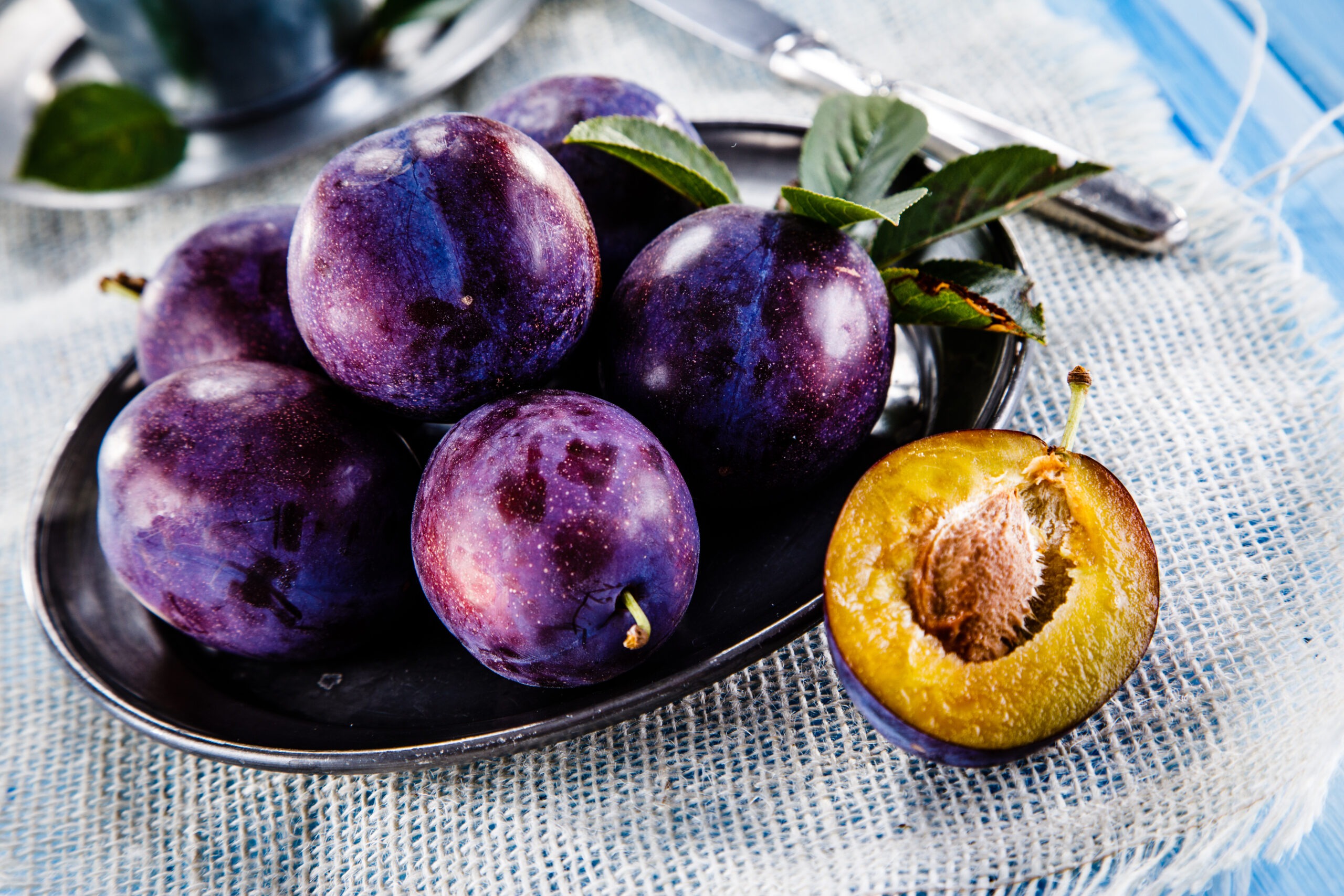
Plums come in many colours, including:
- Purple
- Blue
- Red
- Yellow
- Green
They can be used for both eating and cooking.
Gages
Gages tend to produce particularly sweet, richly flavoured fruit.
Greengages are among the best-known.
They can be absolutely delicious when allowed to ripen properly on the tree.
Good for: Dessert fruit.
Damsons
Damsons are generally smaller and sharper.
They’re particularly useful for:
- Jam
- Preserves
- Chutney
- Cooking
They’re also hardy and can perform well in less-than-perfect conditions.
Good for: Cooking and cooler gardens.
Choosing a Plum Tree
Before buying a tree, consider three things:
Variety
Rootstock
Pollination
The variety determines the fruit.
The rootstock has a major influence on the eventual size of the tree.
And the pollination requirements determine whether another compatible tree may be needed nearby.
Understanding Plum Rootstocks
Most garden plum trees are grafted.
The fruiting variety forms the upper part of the tree while a different root system — the rootstock — controls much of its vigour.
Common plum rootstocks include:
- Pixy
- VVA-1
- St Julien A
- Brompton
Choosing the correct one can be the difference between a manageable garden tree and something far larger than expected.
Pixy Rootstock
Pixy is a dwarfing plum rootstock.
Trees are often kept around:
2.5–3m
depending on growing conditions and pruning.
It can produce fruit relatively young.
Good for: Small gardens and restricted spaces.
It may require support, particularly while young.
VVA-1 Rootstock
VVA-1 is another relatively dwarfing rootstock.
It can produce compact trees suitable for modern gardens.
Typical eventual size can be around:
2.5–3m
depending on variety, soil and training.
Good for: Smaller gardens.
St Julien A Rootstock
St Julien A is one of the most common choices for garden plum trees.
Trees may reach around:
3.5–4.5m
depending on conditions.
It’s less dwarfing than Pixy but provides a good balance between:
- Vigour
- Productivity
- Manageable size
Good for: Medium-sized gardens.
Brompton Rootstock
Brompton produces a considerably more vigorous tree.
It is more appropriate for:
- Large gardens
- Orchards
- Traditional free-standing trees
If your garden is relatively small, this probably isn’t the rootstock to choose.
Which Plum Rootstock Should a Beginner Choose?
For a small garden, look at:
Pixy or VVA-1.
For a medium-sized garden where you have more space:
St Julien A
is an excellent general-purpose option.
Always check the expected mature size before buying.
Don’t judge a tree by its size at the garden centre.
That little tree could look very different ten years from now.
Where Should You Grow a Plum Tree?
Plums prefer:
full sun and shelter.
Sunshine helps the fruit develop sweetness.
Shelter is particularly important because plum trees flower early.
That means blossom can be vulnerable to:
- Cold winds
- Late frost
- Poor pollination conditions
A south- or west-facing position can be excellent.
Avoid Frost Pockets
Cold air naturally sinks and collects in low parts of a garden.
These areas are known as:
frost pockets.
Because plums flower relatively early, frost can damage blossom and reduce the year’s crop.
If possible, avoid planting at the lowest point of a garden where cold air regularly settles.
What Soil Do Plum Trees Need?
Plums prefer soil that is:
- Fertile
- Moisture-retentive
- Well drained
- Rich in organic matter
They appreciate reliable moisture more than some other tree fruits.
However, permanently waterlogged ground can cause root problems.
Very sandy soil can be improved with organic matter.
Heavy soil can grow excellent plums if drainage is adequate.
When to Plant Plum Trees in the UK
Plum trees are available as:
bare-root
or
container-grown trees.
Bare-Root Plum Trees
Plant during the dormant season, generally:
November to March.
Don’t plant when the ground is frozen or waterlogged.
Container-Grown Plum Trees
These can be planted throughout much of the year.
However, autumn and early spring are usually easiest.
Trees planted during warm weather require much more careful watering.
How to Plant a Plum Tree
Dig a planting hole:
wider than the root system but no deeper than necessary.
Loosen the surrounding soil.
Place the tree into the hole.
The graft union should remain:
clearly above soil level.
Spread bare roots naturally.
Backfill with soil.
Firm gently.
Water thoroughly.
Add a suitable stake if required.
Don’t Bury the Graft
Like apple trees, grafted plum trees should be planted with the graft union above the soil.
If the graft becomes buried, the upper variety may produce its own roots.
This can interfere with the size-controlling effect of the rootstock.
Check the final soil level after watering because loose soil can settle.
Should You Stake a Plum Tree?
Young trees often benefit from staking.
Use:
- A sturdy stake
- A proper tree tie
The aim is to stabilise the root system while allowing some natural movement.
Check the tie every year.
Loosen or replace it as the trunk thickens.
Some dwarfing trees may require longer-term support.
Plum Tree Pollination
Pollination requirements vary considerably between varieties.
Some plum trees are:
self-fertile.
Others crop better with another compatible plum nearby.
For a small garden where you only have room for one tree, a self-fertile variety is usually the simplest choice.
Do You Need Two Plum Trees?
Not necessarily.
Several excellent plum varieties are self-fertile.
That means a single tree can produce fruit.
However, another compatible tree flowering nearby may improve cropping in some cases.
Always check the pollination requirements of the specific variety before buying.
Plum Pollination Groups
Like apples, plum varieties flower at different times.
They’re sometimes divided into pollination groups.
For successful cross-pollination, varieties need to:
flower at approximately the same time.
The exact grouping system can vary between nurseries.
Rather than relying solely on a group number, check whether your chosen varieties are specifically described as compatible.
Plum Blossom
Plum trees are beautiful in spring.
Their branches become covered in white blossom, often before much of the garden has properly woken up.
This early flowering is attractive, but it also creates vulnerability.
A warm spell can encourage flowers to open.
Then a sudden frost can damage them.
This is one of the main reasons plum harvests can vary significantly between years.
Protecting Plum Blossom from Frost
Small trees can potentially be protected with:
horticultural fleece
when severe frost is forecast.
Avoid wrapping delicate blossom tightly.
The aim is to provide some protection while maintaining airflow.
Wall-trained trees are easier to protect than large free-standing specimens.
Plum Trees and Pollinating Insects
Bees and other insects play an important role in plum pollination.
Encourage pollinators by growing flowers nearby.
Useful plants include:
- Lavender
- Borage
- Comfrey
- Rosemary
- Thyme
- Spring bulbs
Avoid unnecessary insecticide use while fruit trees are flowering.
Growing Plums Against a Wall
Plums can be trained against a sunny wall or fence.
One common shape is a:
fan.
Fan-trained plums have branches arranged across the support in an open fan shape.
This is useful because it:
- Saves space
- Creates a warm microclimate
- Makes fruit accessible
- Makes frost protection easier
A south- or west-facing wall can be particularly useful in cooler gardens.
Growing Plum Trees in Containers
Yes, dwarf plum trees can be grown in containers.
Choose a tree on a suitable dwarfing rootstock such as:
Pixy or VVA-1.
Use a substantial container.
I’d generally aim for at least:
45–50cm wide
with good depth.
Larger is better for long-term growing.
Use a soil-based compost suitable for permanent plants.
Watering Container Plum Trees
Container-grown plums require careful watering.
During warm weather, they may need water:
every day.
Consistent moisture is particularly important while fruit is developing.
Don’t allow the compost to repeatedly switch between:
bone dry and soaking wet.
This can contribute to fruit splitting and plant stress.
How Often Should You Water Plum Trees?
Newly planted trees need regular watering during their first few growing seasons.
Established trees generally need less attention.
However, water during prolonged drought, particularly while fruits are swelling.
A deep watering is better than repeatedly sprinkling small amounts onto the surface.
Mulching Plum Trees
Apply organic mulch around the tree during spring.
Suitable materials include:
- Well-rotted compost
- Well-rotted manure
- Other suitable organic mulch
Mulching helps:
- Retain moisture
- Suppress weeds
- Improve soil
- Reduce competition
Leave a gap around the trunk.
Don’t pile mulch directly against the bark.
Feeding Plum Trees
A general fruit-tree fertiliser can be applied in spring according to the manufacturer’s instructions.
Container-grown trees need more regular feeding.
Once flowering and fruit development begin, adequate potassium is particularly important.
Avoid excessive nitrogen.
Too much nitrogen encourages vigorous leafy growth and can make pruning more difficult.
When Do Plum Trees Start Producing Fruit?
This depends on:
- Rootstock
- Variety
- Age of tree
- Growing conditions
A grafted young tree may begin producing some fruit within:
around two to four years.
Don’t expect a newly planted tree to immediately produce enormous crops.
Establishing a strong root system and branch structure is more important.
Should You Remove Fruit from a Young Plum Tree?
If a newly planted tree sets a heavy crop, removing some fruit can be beneficial.
The tree needs energy to establish:
- Roots
- Branches
- Leaves
Allowing a very young tree to carry an enormous crop can slow establishment.
A few fruits are fine.
Just don’t ask too much from the tree in its first season.
Should You Thin Plums?
Yes, particularly after a heavy fruit set.
Plum trees can produce enormous numbers of small fruits.
If every fruit remains, you can end up with:
- Smaller plums
- Overloaded branches
- Broken branches
- Poor ripening
Thin the crop once the natural early fruit drop has occurred.
How Far Apart Should Plums Be Thinned?
A useful target is to leave fruits roughly:
5–8cm apart
depending on variety and branch strength.
You don’t need to measure every plum.
The goal is simply to remove severe overcrowding.
Prioritise removing:
- Damaged fruit
- Misshapen fruit
- Very small fruit
- Fruits touching tightly together
Beware of Overloaded Plum Branches
Plum trees can crop so heavily that branches break.
This is especially common on mature trees.
Thinning helps.
If a branch is still heavily loaded, you can use a suitable support to reduce strain.
Don’t wait until the branch has split.
When Should You Prune Plum Trees?
This is one of the most important parts of the guide.
Unlike apples and pears, plum trees should generally be pruned during:
spring or summer.
Avoid routine winter pruning.
This helps reduce the risk of diseases such as:
silver leaf.
Young trees are often shaped in spring.
Established trees can be pruned during summer after growth has developed.
Why Shouldn’t You Prune Plums in Winter?
Winter pruning can increase the risk of infection by silver leaf disease.
The fungus can enter through pruning wounds.
During the growing season, wounds heal more rapidly.
For this reason, save your winter pruning sessions for apples and pears.
Prune plums during suitable dry weather in spring or summer instead.
How to Prune a Plum Tree
Start with the basics.
Remove:
Dead
Diseased
Damaged
branches.
Then look for:
- Crossing branches
- Rubbing branches
- Congested growth
- Shoots growing into the centre
Aim for a reasonably open structure that allows:
- Light
- Air
- Easy harvesting
Avoid removing huge amounts of growth in one year.
Pruning Young Plum Trees
Young trees need formative pruning to create a strong framework.
You generally want several well-spaced main branches rather than a congested cluster.
Think about the tree’s future shape before cutting.
A well-shaped young tree is much easier to manage later.
Pruning Established Plum Trees
Mature trees usually need relatively light pruning.
Focus on:
- Removing damaged wood
- Controlling excessive height
- Reducing congestion
- Maintaining a manageable shape
Plums don’t generally require aggressive annual pruning.
What Is Silver Leaf?
Silver leaf is a fungal disease that can affect plum and other stone-fruit trees.
One characteristic symptom is foliage developing a:
silvery appearance.
Branches can eventually die.
The disease can enter through wounds.
Reducing unnecessary pruning and pruning during the recommended season helps lower the risk.
Bacterial Canker
Bacterial canker is another important plum disease.
Symptoms can include:
- Sunken areas of bark
- Dead branches
- Gum oozing from the tree
- Dieback
Remove affected material where practical and maintain good tree health.
Again, correct pruning timing is important.
What Is Gummosis?
You may sometimes notice a sticky amber substance leaking from a plum tree.
This is called:
gummosis.
It isn’t a disease itself.
It’s a symptom of stress or damage.
Possible causes include:
- Canker
- Physical injury
- Pest damage
- Environmental stress
Investigate the surrounding bark rather than simply removing the gum.
Plum Moth
Plum moth larvae can tunnel into fruit.
Affected plums may:
- Ripen prematurely
- Contain a caterpillar
- Have damaged flesh
- Drop early
Pheromone traps can be used to monitor adult moth activity.
Remove and dispose of badly affected fruit.
Plum Sawfly
Plum sawfly larvae can damage developing fruits.
Young plums may:
- Develop holes
- Drop prematurely
- Contain larvae
Removing affected fruit can help reduce the number of pests completing their lifecycle.
Aphids
Aphids commonly attack young plum shoots.
They can cause:
- Curled leaves
- Distorted growth
- Sticky honeydew
Natural predators such as ladybirds, hoverflies and lacewings can provide excellent control.
A few aphids don’t necessarily require intervention.
Birds
Birds can become one of the biggest problems just as your plums finally ripen.
They may peck fruit or remove it entirely.
If necessary, protect smaller trees using properly installed fruit netting.
Make sure netting is:
- Secure
- Tensioned
- Checked regularly
- Safe for wildlife
Loose netting can trap birds.
Wasps
Wasps are attracted to ripe and damaged plums.
Once one fruit splits or is pecked, wasps may quickly find it.
Harvest ripe fruit promptly.
Remove damaged and rotting plums.
Don’t leave large quantities of fallen fruit beneath the tree.
Why Are My Plums Splitting?
Fruit splitting is often associated with irregular moisture.
For example:
a prolonged dry period followed by heavy rain.
The fruit suddenly absorbs water and the skin can’t expand quickly enough.
Consistent watering during dry weather can help reduce the problem.
Why Are My Plums Falling Off?
Some early fruit drop is natural.
Other causes include:
- Overcropping
- Drought
- Pest damage
- Disease
- Poor pollination
- Strong winds
If the tree is otherwise healthy and still carrying plenty of fruit, some drop isn’t necessarily a problem.
Why Is My Plum Tree Not Producing Fruit?
Possible causes include:
The tree is too young
Give it time.
Poor pollination
The variety may need a compatible partner.
Frost damaged the blossom
A common problem because plums flower early.
Excessive pruning
Heavy pruning can encourage vegetative growth.
Lack of sunlight
Heavy shade reduces fruiting.
Biennial cropping
Some trees crop more heavily in certain years.
Check each possibility before assuming something is wrong with the tree.
Best Plum Varieties for Beginners
There are many excellent varieties for UK gardens.
Victoria
Probably the best-known British garden plum.
Produces sweet, juicy fruit suitable for:
- Eating
- Cooking
- Preserving
It’s self-fertile and generally reliable.
Good for: Beginners and general-purpose growing.
Opal
An early-ripening plum producing attractive reddish-purple fruit.
Sweet and juicy.
It’s also self-fertile.
Good for: Early crops and smaller gardens.
Jubilee
Produces large, high-quality fruit.
It can be eaten fresh or used for cooking.
Good for: Large dessert plums.
Marjorie’s Seedling
A late-season plum producing dark fruit.
Useful for extending the plum season.
Good for: Later harvests and cooking.
Czar
A traditional dark-purple plum.
It tolerates somewhat less-than-perfect conditions and is useful for cooking.
Good for: Cooler or less sunny gardens.
Cambridge Gage
Produces sweet, richly flavoured greenish-yellow fruit.
Good for: Dessert-quality fruit.
Best Plum Trees for Small Gardens
For smaller gardens, I’d look for:
a self-fertile variety on Pixy or VVA-1 rootstock.
Good variety options include:
- Victoria
- Opal
- Jubilee
A self-fertile tree avoids needing to find room for a second pollination partner.
You could also train a plum as a fan against a wall to use space more efficiently.
Can Plum Trees Grow in Scotland?
Yes.
Plums can grow successfully in Scotland.
The biggest considerations are:
- Early blossom
- Late frost
- Cooler summers
- Wind exposure
Choose a sunny, sheltered position.
A south- or west-facing wall can be particularly useful.
Early and reliable varieties such as Opal or hardy traditional choices can work well.
Local nurseries can be an excellent source of varieties proven in your area.
Can Plums Grow in Partial Shade?
They can tolerate some shade, but:
full sun is strongly preferred.
More sunlight generally means:
- Sweeter fruit
- Better ripening
- Stronger flowering
- Better cropping
If your garden is shaded, choose the sunniest position available.
When Are Plums Ready to Pick?
Most UK plums ripen between:
July and September.
Exact timing depends on variety and location.
A ripe plum should:
- Have developed its mature colour
- Feel slightly soft
- Smell fruity
- Come away relatively easily
Don’t rely on colour alone.
Some varieties remain green even when perfectly ripe.
The Taste Test
One of the best ways to judge ripeness is also the simplest.
Pick one.
Eat it.
If it’s:
- Sweet
- Juicy
- Aromatic
- Soft enough
the rest of the crop is probably approaching harvest.
If it’s hard and sharply acidic, leave the others longer.
Do All Plums Ripen at Once?
No.
Fruit on the same tree may ripen over:
several days or weeks.
That’s useful.
You don’t necessarily have to process the entire crop on one afternoon.
Check the tree regularly and pick ripe fruit as it becomes ready.
How to Harvest Plums
Handle ripe plums gently.
They bruise very easily.
Cup the fruit in your hand and twist gently.
If ripe, it should separate without much force.
Place fruit carefully into a shallow container.
Don’t drop plums into a deep bucket.
How to Store Fresh Plums
Perfectly ripe plums don’t store for particularly long.
Keep them somewhere cool or refrigerate them.
Handle them carefully because bruised fruit deteriorates rapidly.
If you have a huge harvest, consider:
- Freezing
- Jam
- Chutney
- Bottling
- Cooking
Can You Freeze Plums?
Yes.
Plums freeze very well for cooking.
A simple method is:
- Wash the fruit.
- Cut in half.
- Remove the stone.
- Spread halves on a tray.
- Freeze.
- Transfer to freezer containers.
They’re excellent later for:
- Crumbles
- Pies
- Compotes
- Sauces
Can You Grow a Plum Tree from a Stone?
Yes.
But the resulting tree won’t necessarily produce the same fruit as the parent.
It may also become much larger than a grafted garden tree.
If you want predictable:
- Fruit quality
- Tree size
- Cropping
buy a grafted named variety.
Growing a plum stone is better treated as an experiment.
What Can You Grow Under a Plum Tree?
Under established trees you can potentially grow:
- Spring bulbs
- Herbs
- Strawberries
- Low-growing flowers
Pollinator-friendly plants are particularly useful.
Keep the immediate root area of newly planted trees clear of heavy competition.
Grass can compete strongly for water and nutrients.
Growing Wildflowers Near Plum Trees
Wildflowers can be excellent companions.
They attract:
- Bees
- Hoverflies
- Other beneficial insects
This is particularly useful because plum blossom depends heavily on insect activity.
Choose flowers that bloom around spring as well as summer.
Growing Plums Month by Month
| Month | What to do |
|---|---|
| January | Plant bare-root trees; avoid pruning |
| February | Continue planting while dormant |
| March | Watch early blossom and protect from frost |
| April | Pollination and flowering; begin suitable spring pruning |
| May | Water young trees and monitor fruit set |
| June | Thin heavy crops and support overloaded branches |
| July | Harvest early varieties and summer-prune |
| August | Main harvesting period for many varieties |
| September | Harvest later plums |
| October | Clear fallen fruit and mulch if required |
| November | Begin bare-root planting |
| December | Plant during suitable weather; avoid winter pruning |
What You’ll Need to Grow Plums
Plum trees don’t require a huge amount of equipment.
I’d recommend:
A suitable grafted plum tree
Tree stake and ties
Spade
Well-rotted compost
Organic mulch
Watering can or garden hose
Fruit-tree fertiliser
Bypass secateurs
Pruning saw for mature trees
Horticultural fleece for frost protection
Fruit netting if birds become a problem
As with apples, your most important purchase is the tree itself.
Choose the right:
variety, rootstock and pollination type
before worrying about accessories.
[See Our Recommended Secateurs →]
[See Our Recommended Fruit Tree Fertilisers →]
[See Our Recommended Fruit Netting →]
[See Our Recommended Tree Stakes & Ties →]
[Essential Equipment Every Gardener Needs →]
Plum Growing FAQs
Are plum trees easy to grow?
Yes. Plum trees are relatively easy once established, although correct pruning timing and protection of early blossom are important.
When should I plant a plum tree in the UK?
Bare-root trees are generally planted between November and March. Container-grown trees can be planted over a much longer period.
How long does a plum tree take to produce fruit?
Many grafted trees begin producing some fruit within around two to four years, depending on age, rootstock and growing conditions.
Do I need two plum trees?
Not necessarily. Many varieties, including Victoria and Opal, are self-fertile.
What is the best plum tree for beginners?
Victoria is an excellent all-round choice because it’s self-fertile, productive and useful for both eating and cooking.
Can plum trees grow in pots?
Yes. Choose a dwarfing rootstock and use a large container.
Do plum trees need full sun?
Full sun is strongly recommended for the best fruit quality and ripening.
When should plum trees be pruned?
Plum trees are generally pruned during spring or summer, rather than winter.
Why shouldn’t plum trees be pruned in winter?
Winter pruning can increase the risk of diseases such as silver leaf entering through pruning wounds.
Should I thin plums?
Yes, if the tree is carrying an extremely heavy crop. Thinning improves fruit size and reduces the risk of broken branches.
Why is my plum tree flowering but not producing fruit?
Possible causes include poor pollination, frost-damaged blossom, bad weather during flowering or incompatible pollination partners.
When are plums ready to harvest?
Depending on variety, UK plums generally ripen from July through September.
Can plum trees grow in Scotland?
Yes. Choose a sunny, sheltered position and varieties suited to cooler conditions.
Can you grow a plum tree from a stone?
Yes, but the resulting tree won’t reliably produce the same variety and may grow considerably larger than a grafted tree.
Final Thoughts
A plum tree is an excellent choice if you want to add permanent fruit production to your garden.
For a beginner, the easiest starting point is usually:
a self-fertile variety on a manageable rootstock.
If you have a small garden, look for something like Victoria or Opal on Pixy or VVA-1.
If you have more room, a tree on St Julien A can produce a substantial crop while remaining manageable with sensible pruning.
Give it the sunniest, most sheltered position you can.
Water it properly while it establishes.
Thin the fruit if branches become overloaded.
And remember the most important difference between your apple and plum trees:
don’t automatically prune your plum in winter.
Stick to appropriate spring and summer pruning to reduce the risk of silver leaf disease.
Get those basics right and a plum tree can become one of the most productive plants in your garden.
There may eventually be years when your biggest problem isn’t how to grow plums.
It’s working out what to do with several kilograms of them before they all ripen.
That’s when it’s time to start making crumble, jam and chutney.