Gardeners Guide · Grow your own
Rhubarb is one of the easiest perennial crops you can grow in a UK garden.
Plant it once, give it a good position and a little care each year, and it can keep producing for many years.
That makes rhubarb very different from most vegetables.
You don’t need to sow it every spring or replant it annually. Once established, the crown sits in the ground year after year and sends up fresh stalks each spring.
It’s also well suited to the British climate.
Rhubarb likes cool conditions, tolerates winter cold and is traditionally one of the first home-grown crops to harvest in spring.
In this beginner’s guide, we’ll cover how to grow rhubarb in the UK, when and how to plant crowns, growing rhubarb in containers, feeding, watering, dividing mature plants, forcing rhubarb and when to harvest it.
Rhubarb at a Glance
| Rhubarb | |
|---|---|
| Plant crowns | Autumn to early spring |
| Harvest | March–July |
| Position | Full sun or light shade |
| Difficulty | Easy |
| Spacing | Around 75–90cm |
| Containers | Possible in very large pots |
| Soil | Fertile, moisture-retentive and well drained |
| Watering | Regularly during dry weather |
| Feeding | Annually |
| Frost hardy | Yes |
| Lifespan | Many years |
| Edible part | Stalks only |
Why Grow Rhubarb?
Rhubarb is one of those crops that rewards patience.
Once established, a healthy plant can produce generous stalks every spring with relatively little work.
It’s excellent for:
- Crumbles
- Pies
- Compotes
- Jams
- Chutneys
- Cakes
- Cordials
- Desserts
Home-grown rhubarb can also be much more interesting than supermarket rhubarb because you can choose different varieties with different stalk colours, cropping times and vigour.
And because it’s perennial, one plant can become a long-term feature in the garden.
Is Rhubarb a Fruit or a Vegetable?
Botanically, rhubarb is a vegetable.
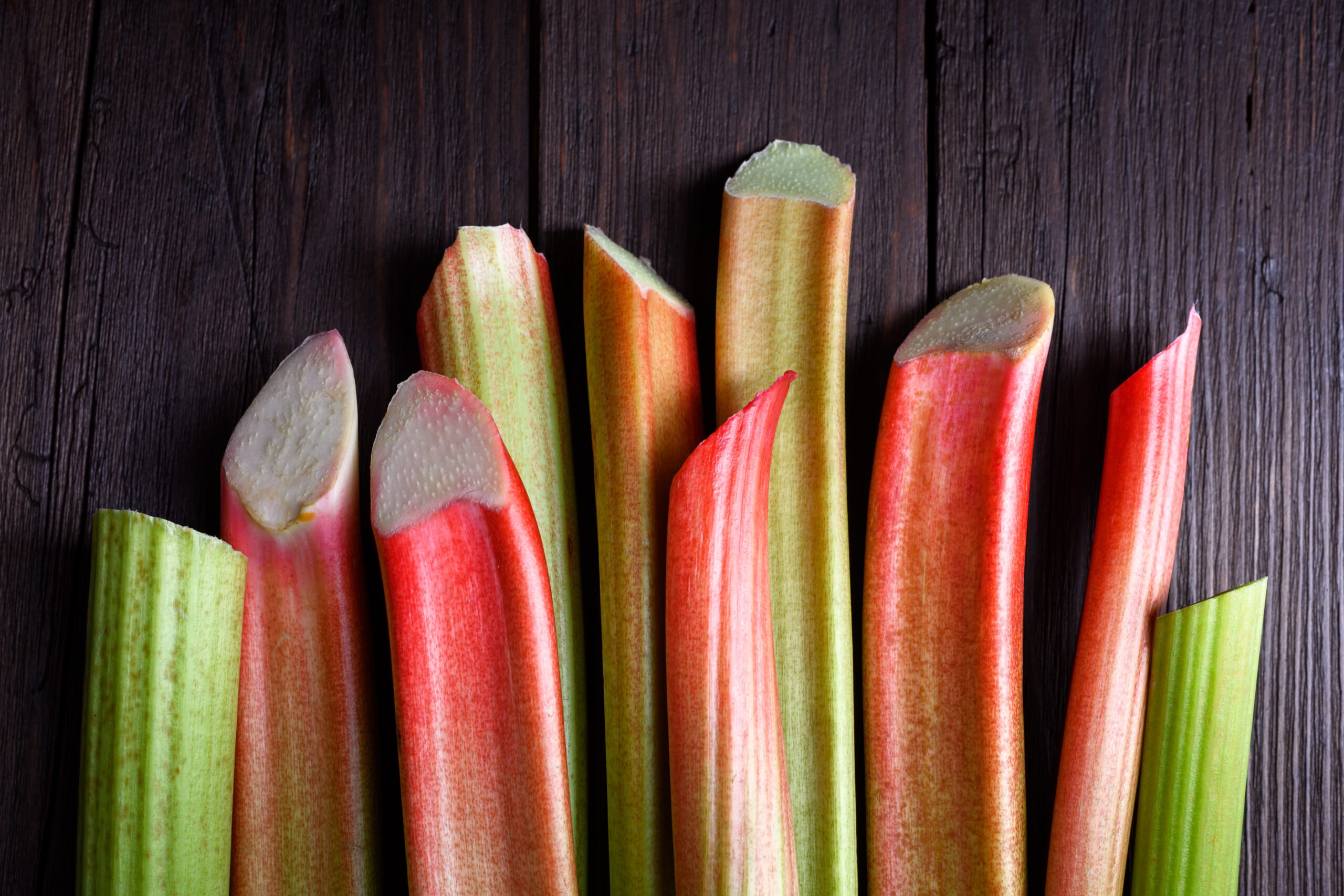
The edible part is the fleshy leaf stalk, known as the petiole.
However, it’s usually cooked and served like fruit.
That’s why it tends to appear in desserts, jams and puddings rather than alongside carrots and cabbage.
For gardeners, the classification doesn’t really matter.
What matters is that only the stalks are eaten.
Important: Never Eat Rhubarb Leaves
Rhubarb leaves are not edible.
They contain high levels of oxalic acid and other compounds that can be harmful if eaten.
The stalks are the part you harvest and cook.
The leaves should be removed and discarded or composted.
Do not use them in food.
When to Plant Rhubarb in the UK
Rhubarb is usually planted as a crown.
A crown is a section of established root containing one or more buds.
The best planting period is generally:
autumn through early spring
while the plant is dormant.
Avoid planting when the soil is:
- Frozen
- Waterlogged
- Extremely dry
Container-grown rhubarb can be planted over a longer period, but autumn and spring remain good times.
Should You Grow Rhubarb from Seed?
You can, but most beginners are better off planting crowns.
Seed-grown rhubarb:
- Takes longer to establish
- Can vary more in quality
- Is slower to reach useful cropping size
Crowns give you a much quicker and more predictable start.
If your goal is a dependable crop, buy a named variety as a crown.
Where Should You Grow Rhubarb?
Rhubarb likes a position with:
full sun or light shade.
It also wants:
- Deep soil
- Plenty of organic matter
- Reliable moisture
- Good drainage
Avoid very dry, shallow soil.
Also avoid spots that stay waterlogged in winter.
Because rhubarb can remain in the same place for many years, choose the location carefully.
How Much Space Does Rhubarb Need?
Rhubarb plants become large.
A mature plant can easily spread around:
75–90cm or more.
Give each crown plenty of room.
Crowding several plants too tightly can reduce airflow and make harvesting awkward.
For a small household, one or two healthy crowns may be enough.
Preparing the Soil
Rhubarb is a hungry plant.
Before planting, improve the soil with:
well-rotted compost or manure.
Dig it in over a reasonably wide area rather than creating one tiny rich pocket.
The ideal soil is:
- Fertile
- Moisture-retentive
- Well drained
- Rich in organic matter
This preparation is worth doing properly because the crown may remain there for many years.
How to Plant Rhubarb Crowns
Dig a hole large enough to accommodate the crown comfortably.
Place the crown into the hole.
The top of the crown should sit around:
at or just below soil level.
Avoid burying it deeply.
Backfill with soil and firm gently.
Water well.
Mark the position if the crown is dormant and not yet visible above ground.
How Deep Should Rhubarb Be Planted?
Rhubarb crowns should not be buried deeply.
Keep the crown close to soil level.
If planted too deeply, the crown can struggle or rot.
The exact depth depends on the crown, but the growing buds should sit close to the surface.
Can Rhubarb Grow in Containers?
Yes, but it needs a very large container.
Rhubarb has a substantial root system and is much happier with plenty of space.
For long-term growing, use a container of at least:
40–50 litres
and preferably larger.
Choose a deep, heavy pot with good drainage.
Fill it with a rich, soil-based compost or a mixture suitable for long-term growing.
Container-grown rhubarb needs much more attention to watering and feeding than plants in the ground.
Is Rhubarb Good for Raised Beds?
Yes.
Raised beds can be excellent if your garden soil is:
- Heavy
- Poorly drained
- Difficult to improve
Make sure the raised bed is deep enough.
Because rhubarb stays in place for years, consider whether you’re happy to dedicate part of the bed permanently to one crop.
How Often Should You Water Rhubarb?
Rhubarb likes reliable moisture.
Newly planted crowns need regular watering while they establish.
Established plants are relatively resilient but benefit from deep watering during prolonged dry spells.
Dry conditions can produce thinner stalks and reduce the overall crop.
The goal is:
consistent moisture without waterlogging.
Should You Mulch Rhubarb?
Yes.
Rhubarb responds very well to annual mulching.
In late winter or early spring, apply a generous layer of:
well-rotted compost or manure
around the plant.
This helps:
- Feed the plant
- Retain moisture
- Suppress weeds
- Improve the soil
Keep mulch slightly away from the crown itself.
Do not bury the crown under a thick wet layer.
Does Rhubarb Need Feeding?
Usually, an annual mulch with rich organic matter provides much of what rhubarb needs.
You can also apply a suitable general-purpose fertiliser in spring.
Avoid excessive nitrogen.
Too much can produce lots of leafy growth without necessarily improving stalk quality.
Container plants generally need more regular feeding because nutrients are more limited.
Keep Rhubarb Weed-Free
Young rhubarb plants dislike competition.
Keep the area around the crown reasonably clear.
Hand weeding is safest close to the plant.
Avoid digging deeply around established crowns because the roots can sit near the surface.
Mulching reduces the need for weeding.
When Can You Harvest Rhubarb?
This depends on how established the plant is.
A newly planted crown should usually be given time to settle.
For a first-year crown, it’s best to:
avoid harvesting heavily.
You may take little or nothing in the first year.
In the second year, harvest lightly.
From the third year onward, established plants can usually be harvested more normally.
Patience early on gives you stronger plants later.
Why You Shouldn’t Harvest Too Much in the First Year
The plant needs its leaves to photosynthesise and build energy reserves in the crown.
If you remove too many stalks too soon, the plant can become weak.
Think of the first year as an investment in the future crop.
A strong crown can reward you for years.
When Is Rhubarb Ready to Pick?
Rhubarb is usually ready when the stalks are:
around 30cm or more in length
and reasonably thick.
Colour isn’t always the best guide.
Some varieties stay greener than others.
What matters is that the stalks have reached a useful size.
How to Harvest Rhubarb Properly
Do not cut the stalks with a knife.
Instead:
- Hold a stalk close to the base.
- Pull gently upwards.
- Twist slightly as you pull.
- The stalk should separate from the crown.
This is the traditional harvesting method.
Remove the leaf immediately and discard it.
Why Pull Rhubarb Instead of Cutting It?
Cutting can leave a short stump behind.
That stump may rot.
Pulling removes the stalk cleanly from the crown.
For this reason, pulling is generally preferred.
How Much Rhubarb Should You Harvest?
Never strip the entire plant.
Leave plenty of healthy leaves behind.
As a rough rule, try to leave at least:
one third to half of the stalks
on the plant at any one time.
This allows it to keep producing energy.
When Should You Stop Harvesting Rhubarb?
A good general rule is to stop harvesting by:
mid to late summer, often around July.
After that, allow the plant to keep its leaves.
Those leaves help recharge the crown for the following year.
Continuing to harvest heavily into late summer can weaken the plant.
What Is Forced Rhubarb?
Forced rhubarb is grown in darkness so the stalks stretch towards light.
This produces stalks that are:
- Paler
- More tender
- Sweeter
- Less fibrous
It also gives you an earlier crop.
You may have seen bright pink forced rhubarb in shops during winter.
How to Force Rhubarb at Home
You can force an established crown using:
- A rhubarb forcing pot
- An upturned dustbin
- A large bucket
- Another light-blocking container
In late winter:
- Cover the crown completely.
- Block out as much light as possible.
- Leave it in place for several weeks.
- Harvest the pale stalks once they’re long enough.
Only force strong, established crowns.
How Often Can You Force Rhubarb?
Not every year.
Forcing uses a lot of stored energy.
Give a forced crown time to recover.
A common approach is to force a plant only every:
two or three years.
If you have several crowns, rotate which one you force.
Should You Remove Rhubarb Flowers?
Yes, generally.
Mature rhubarb plants may send up tall flowering stalks.
These can look impressive, but flowering diverts energy away from stalk production.
Remove flower stems as soon as they appear.
Cut or pull them close to the base.
Why Is My Rhubarb Flowering?
Flowering can happen because:
- The plant is mature
- The variety is prone to flowering
- The plant is under stress
- Conditions have been unusually dry
Remove the flower stalk and improve growing conditions where necessary.
Can Rhubarb Be Divided?
Yes.
Dividing is a great way to rejuvenate an old plant or create new plants.
The best time is usually:
late autumn or early spring
while the plant is dormant.
Lift the crown carefully and split it into sections.
Each section should have:
- A healthy bud
- A good piece of root
Replant immediately.
How Often Should Rhubarb Be Divided?
Rhubarb can remain productive for many years.
However, older crowns may become congested or less productive.
Dividing every:
5–10 years
can help rejuvenate the plant.
You don’t need to divide a healthy, productive crown just because a certain number of years has passed.
Best Rhubarb Varieties for Beginners
There are several excellent UK varieties.
Timperley Early
A popular early variety.
Produces reliable crops and is often used for forcing.
Good for: Early harvests.
Victoria
A classic traditional variety.
Produces long stalks and is widely grown.
Good for: General-purpose growing.
Champagne
Known for tender stalks and a good flavour.
Often suitable for forcing.
Good for: Early and tender crops.
Raspberry Red
Produces attractive red stalks.
Usually relatively compact.
Good for: Colour and smaller gardens.
Stockbridge Arrow
A well-known Yorkshire variety associated with the traditional rhubarb-growing area.
Good for: Strong cropping and classic rhubarb flavour.
Can Rhubarb Grow in Scotland?
Yes.
Rhubarb is extremely well suited to Scottish conditions.
It appreciates cooler weather and winter dormancy.
The main things to watch are:
- Waterlogging
- Very exposed positions
- Poor drainage
Choose a fertile, sheltered position and rhubarb can perform extremely well.
Can Rhubarb Grow in Partial Shade?
Yes.
Rhubarb can tolerate light shade.
Full sun usually gives the strongest growth, but a position with part-day sun can still produce a useful crop.
Avoid very deep shade.
Can Rhubarb Survive Frost?
Yes.
Rhubarb is very hardy.
The crown survives winter underground and begins growing again as conditions improve.
Late frost may damage emerging leaves, but established plants usually recover.
Common Rhubarb Problems
Rhubarb is generally trouble-free, but a few problems are worth knowing about.
Crown Rot
Crown rot is one of the most serious issues.
Signs can include:
- Soft tissue
- Browning
- Rotting at the crown
- Weak growth
It’s often associated with:
poor drainage and waterlogging.
Avoid burying the crown too deeply.
Plant in well-drained soil.
Badly affected crowns may need to be removed.
Slugs and Snails
Slugs and snails may damage young leaves.
Established rhubarb can usually tolerate moderate damage.
Check around young plants and keep the area reasonably tidy.
Why Are My Rhubarb Stalks Thin?
Possible reasons include:
The plant is too young
Give it time.
Overcrowding
Old congested crowns may need dividing.
Dry soil
Rhubarb likes moisture.
Poor soil fertility
Feed and mulch annually.
Too much harvesting
The crown may have been weakened.
Why Is My Rhubarb Turning Yellow?
Yellowing leaves can be caused by:
- Natural ageing
- Drought
- Waterlogging
- Nutrient problems
- Disease
Leaves naturally decline later in the season.
If the plant is healthy overall, some yellowing is normal.
Why Isn’t My Rhubarb Growing?
Possible causes include:
- A newly planted crown still establishing
- Poor drainage
- Drought
- Deep planting
- Poor soil
- Crown damage
Check the crown isn’t buried too deeply and the area isn’t waterlogged.
Can You Eat Green Rhubarb Stalks?
Yes.
Not all rhubarb turns bright red.
Some varieties remain green or greenish even when ready.
Colour doesn’t determine safety.
What matters is that you eat the stalks, not the leaves.
Can You Eat Rhubarb Raw?
Rhubarb stalks can technically be eaten raw, but they’re extremely tart.
Most people cook them with sugar or other sweet ingredients.
Never eat the leaves.
Is Rhubarb Poisonous?
The stalks are edible.
The leaves are not.
Rhubarb leaves contain high levels of oxalates and should never be eaten.
Remove and discard the leaves before cooking.
Can You Compost Rhubarb Leaves?
Yes.
Rhubarb leaves can be composted safely.
The compounds they contain break down during decomposition.
Just don’t eat them or feed them to people or pets.
What Can You Grow Near Rhubarb?
Because rhubarb becomes large, don’t crowd it.
You can grow other crops nearby, but give the crown enough space.
Suitable neighbours can include:
- Lettuce
- Radishes
- Spring onions
- Strawberries
These can be grown in surrounding areas before the rhubarb foliage fully expands.
Growing Rhubarb with Strawberries
Rhubarb and strawberries can work well in the same general area because both are perennial food crops.
However, keep enough distance between them.
Mature rhubarb leaves create significant shade.
Strawberries need good light for the best fruit.
Can You Grow Rhubarb from a Piece of Root?
Yes, provided the root section includes a healthy bud.
This is effectively what happens when dividing an established crown.
A piece of root without a viable growing bud won’t produce a proper new plant.
How Long Does Rhubarb Live?
A healthy rhubarb crown can remain productive for:
many years, often a decade or more.
With good care and occasional division, it can last much longer.
That makes it one of the best-value perennial crops in the garden.
How to Store Fresh Rhubarb
Fresh rhubarb is best used reasonably quickly.
Trim the leaves completely.
Store the stalks in the refrigerator.
They can remain usable for several days.
For longer storage, freezing is extremely effective.
Can You Freeze Rhubarb?
Yes.
Rhubarb freezes very well.
A simple method is:
- Wash the stalks.
- Trim the ends.
- Cut into chunks.
- Spread on a tray.
- Freeze until firm.
- Transfer to freezer bags or containers.
Freezing pieces individually first stops them sticking together.
Frozen rhubarb is excellent for crumbles, compotes and baking.
Growing Rhubarb Month by Month
| Month | What to do |
|---|---|
| January | Force established crowns if desired |
| February | Plant crowns and continue forcing |
| March | Main growth begins and early harvesting may start |
| April | Harvest established plants and mulch |
| May | Continue harvesting and water during dry spells |
| June | Main harvesting period |
| July | Finish heavy harvesting and allow plants to recover |
| August | Leave foliage to feed the crown |
| September | Continue allowing plants to build reserves |
| October | Foliage begins dying back |
| November | Plant or divide dormant crowns |
| December | Plant while dormant if conditions allow |
What You’ll Need to Grow Rhubarb
Rhubarb requires very little specialist equipment.
I’d recommend:
A healthy rhubarb crown
Spade
Garden fork
Well-rotted compost or manure
Organic mulch
Watering can or garden hose
General-purpose fertiliser
Large container if growing in pots
Rhubarb forcing pot if you want an early forced crop
The most important thing is not buying lots of equipment.
It’s choosing a good crown and preparing the soil properly.
[See Our Recommended Rhubarb Crowns →]
[See Our Recommended Rhubarb Forcing Pots →]
[See Our Recommended Garden Compost →]
[Essential Equipment Every Gardener Needs →]
Rhubarb Growing FAQs
Is rhubarb easy to grow?
Yes. Rhubarb is one of the easiest perennial crops for beginners.
When should I plant rhubarb in the UK?
Plant crowns from autumn through early spring while the plant is dormant.
How long does rhubarb take to establish?
Allow at least one full season before harvesting heavily. Full productivity generally improves over the following years.
Should I harvest rhubarb in the first year?
It’s best to avoid heavy harvesting during the first year so the crown can establish properly.
Does rhubarb need full sun?
Full sun is ideal, but light shade is usually tolerated.
Can rhubarb grow in pots?
Yes, but use a very large container and keep it well watered and fed.
How far apart should rhubarb be planted?
Allow around 75–90cm between plants, depending on variety.
When should rhubarb be harvested?
Most rhubarb is harvested from spring through early summer, with heavy harvesting usually stopped by around July.
How do you harvest rhubarb?
Pull stalks gently from the base with a slight twist rather than cutting them.
Can you eat rhubarb leaves?
No. Rhubarb leaves are not edible and should never be eaten.
Should rhubarb flowers be removed?
Yes. Removing flower stalks allows the plant to direct more energy into the crown and leaves.
Can rhubarb be divided?
Yes. Mature plants can be divided during dormancy to rejuvenate the crown or create new plants.
Can rhubarb grow in Scotland?
Yes. Rhubarb is very well suited to cooler Scottish conditions.
What is forced rhubarb?
Forced rhubarb is grown in darkness to produce earlier, paler and more tender stalks.
How long can a rhubarb plant live?
A healthy crown can remain productive for many years and can be rejuvenated by dividing it when necessary.
Final Thoughts
Rhubarb is one of the easiest ways to add a permanent food crop to your garden.
It doesn’t need annual sowing.
It doesn’t require a greenhouse.
It tolerates British winters.
And once established, it comes back every spring.
The biggest mistake beginners make is often harvesting too much too soon.
Plant a good crown.
Prepare the soil well.
Give it space.
Mulch it each year.
Keep it watered during dry periods.
Then be patient.
Let the plant establish properly before asking too much from it.
After that, a healthy crown can provide stalks for years.
For a beginner, I’d start with one or two crowns of a reliable variety such as Timperley Early or Victoria.
If you have more than one established plant, you can eventually experiment with forcing one for an earlier crop while allowing the other to grow normally.
And once spring arrives, there’s something particularly satisfying about seeing those first tightly folded rhubarb leaves push through bare soil.
It’s one of the clearest signs that the growing season is starting again.