Gardeners Guide · Grow your own
Leeks are one of the most useful vegetables you can grow in a UK garden.
They’re hardy, dependable, well suited to cooler weather and can remain in the ground through autumn and winter until you’re ready to use them. That makes them especially valuable when many summer vegetables have finished.
They’re also easier to grow than they first appear.
The only part that tends to confuse beginners is the planting method. Leeks are often transplanted into deep planting holes rather than planted in the same way as most vegetables. That helps create the long, pale stems we want at harvest time.
In this beginner’s guide, we’ll cover when to sow leeks in the UK, how to transplant them, spacing, watering, feeding, blanching, common pests and diseases, and how to harvest them successfully.
Leeks at a Glance
| Sow | February–April |
| Plant outside | May–July |
| Harvest | August–March, depending on variety |
| Position | Full sun or light shade |
| Difficulty | Easy |
| Spacing | Around 15cm |
| Row spacing | Around 30cm |
| Containers | Possible |
| Soil | Fertile, moisture-retentive and well drained |
| Watering | Regularly during dry weather |
| Frost hardy | Yes, many varieties |
Why Grow Leeks?
Leeks are especially useful because they can provide a crop during the colder months.
A well-planned leek bed can keep producing from late summer right through winter and into early spring.
They’re also extremely versatile in the kitchen.
Leeks are excellent in:
- Soups
- Stews
- Pies
- Gratins
- Pasta dishes
- Stir-fries
- Roasted vegetable dishes
Unlike many crops, you don’t need to harvest all your leeks at once.
Leave them in the ground and lift them as required.
That means your vegetable bed effectively becomes a natural storage area.
When to Sow Leeks in the UK
Leeks have a relatively long growing season.
For most UK gardeners, sowing usually takes place between:
February and April.
Earlier sowings generally produce larger leeks.
Later sowings may still produce a useful crop, particularly if you’re happy with smaller stems.
A simple schedule looks like this:
February
Start early varieties under cover.
March
Excellent main sowing month.
April
Continue sowing for later crops.
May–July
Transplant established seedlings into their final positions.
How to Sow Leek Seeds
Leeks are easy to start from seed.
You can sow them in:
- Seed trays
- Modules
- Pots
- Outdoor seedbeds
For beginners, I’d usually recommend starting them in trays or pots.
Fill the container with seed compost.
Scatter the seeds thinly across the surface.
Cover with approximately:
1cm of compost.
Water gently.
Keep the compost moist while germination takes place.
Leek seedlings are very distinctive.
They emerge looking like tiny blades of grass.
Don’t worry if they seem incredibly thin at first.
They’ll gradually strengthen.
Can You Sow Leeks Directly Outside?
Yes.
You can sow leeks directly into a prepared outdoor seedbed.
This works well if you have enough space.
Sow thinly in shallow drills and keep the soil moist.
Once the seedlings are large enough, they can be lifted and transplanted into their final growing positions.
For many beginners, however, starting them in containers is easier because it gives you more control over watering and weeds.
When Are Leek Seedlings Ready to Transplant?
Traditionally, gardeners wait until leek seedlings are roughly:
pencil thickness
before transplanting them.
They may also be around:
15–20cm tall.
Don’t worry if yours are slightly smaller.
Healthy seedlings establish surprisingly well.
The main thing is that they’ve developed a reasonable root system and are strong enough to handle.
Preparing the Soil for Leeks
Leeks appreciate fertile soil.
Before planting, improve poorer ground with:
well-rotted compost or organic matter.
The ideal soil is:
- Fertile
- Moisture-retentive
- Well drained
- Reasonably deep
- Free from perennial weeds
Leeks remain in the ground for a long time, so it’s worth preparing the bed properly before planting.
Avoid very dry soil if possible.
A deep, fertile bed helps produce thicker stems.
Where Should You Grow Leeks?
Leeks perform best in:
full sun
although they’ll tolerate some light shade.
Choose a bed that doesn’t become waterlogged in winter.
That’s important because many leeks remain in the ground throughout the colder months.
If your soil is heavy and holds water badly, raised beds can help improve drainage.
The Traditional Leek Planting Method
This is the part that looks strange the first time you do it.
Instead of digging a normal planting hole and filling it back in, many gardeners create a deep hole and simply drop the leek seedling inside.
Here’s how.
Use a dibber or similar tool to make a hole approximately:
15cm deep.
Space holes around:
15cm apart.
Lift a leek seedling carefully.
Trim only damaged roots if necessary.
Drop the leek into the hole so the roots sit at the bottom.
Then:
don’t fill the hole with soil.
Instead, water into the hole.
The water settles soil around the roots naturally.
Over time, rain and cultivation gradually fill the hole.
This method helps produce longer pale stems.
Should You Trim Leek Roots and Leaves?
You’ll sometimes see traditional advice recommending trimming leek roots and leaves before planting.
It isn’t essential.
Modern growing advice generally suggests handling young plants gently and avoiding unnecessary cutting unless roots are excessively long or damaged.
If the roots are too long to fit comfortably into the planting hole, you can shorten them slightly.
Avoid severe trimming.
Healthy roots help the plant establish quickly.
How Far Apart Should Leeks Be?
A good general spacing is:
15cm between plants
with around:
30cm between rows.
Closer spacing produces smaller leeks.
Wider spacing gives plants more room to develop thicker stems.
If you prefer baby leeks, plant more closely.
For larger winter leeks, give them more space.
Always check the seed packet because varieties differ.
How Deep Should Leeks Be Planted?
The planting hole is commonly around:
15cm deep.
The leek itself isn’t buried completely.
The seedling is placed into the hole and allowed to settle.
As the season progresses, soil gradually fills around the stem.
This helps blanch the lower section.
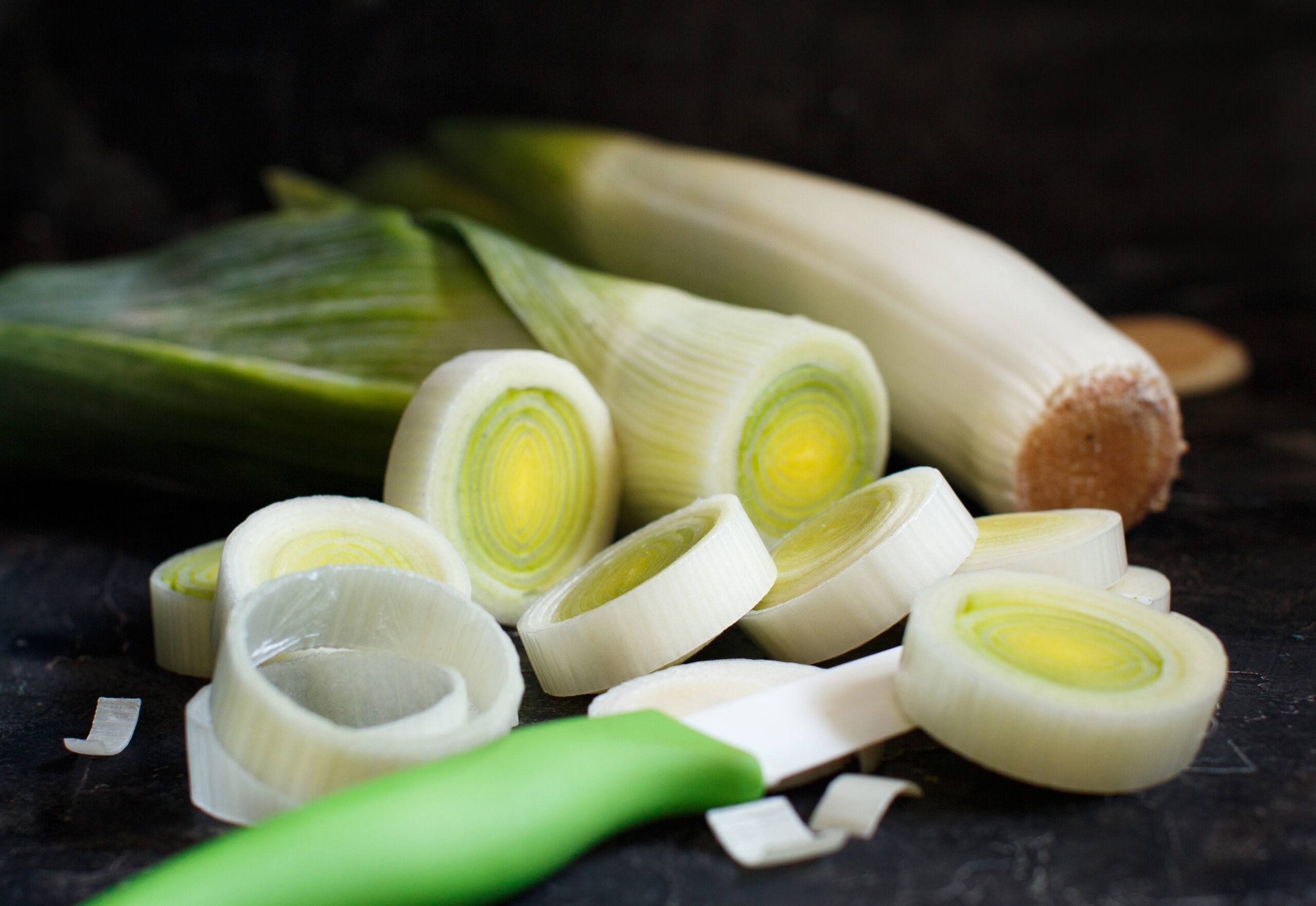
What Is Blanching?
Blanching is the process of excluding light from the lower stem.
The portion of leek kept away from light remains:
white and tender.
The section exposed to light becomes green.
Long white stems are desirable because they’re generally more tender and easier to use in cooking.
There are several ways to increase the blanched section.
How to Blanch Leeks
The simplest method is the traditional deep-hole planting technique.
As the plant grows, you can also gently draw soil around the base.
This is called:
earthing up.
Add soil gradually.
Don’t dump a huge amount into the centre of the leaves.
Soil trapped inside the leaves can end up inside the leek.
Some gardeners also use collars or cardboard tubes around the stems to exclude light.
Growing Leeks in Containers
Leeks can be grown in containers.
You’ll get the best results from a deep pot or planter.
Aim for at least:
25–30cm of soil depth.
A wider container allows several plants to grow together.
Fill it with good-quality multipurpose compost.
Space plants around:
10–15cm apart.
Container-grown leeks may not become as large as those in a deep vegetable bed, but they can still produce an excellent crop.
They also make sense if:
- Your garden soil is poor
- You only have a patio
- Drainage is a problem
- You want baby leeks
Growing Leeks in Raised Beds
Raised beds are excellent for leeks.
They provide:
- Deep cultivated soil
- Good drainage
- Easy access
- Better control over fertility
If you’re growing leeks alongside other vegetables, remember that they occupy the bed for a long period.
A crop planted in early summer may still be there in February.
Plan your vegetable rotation accordingly.
How Often Should You Water Leeks?
Leeks appreciate steady moisture while growing.
Water particularly during:
- Establishment after transplanting
- Dry summer weather
- Extended warm periods
Once autumn arrives, rainfall often provides sufficient moisture.
Deep watering is better than repeatedly wetting only the soil surface.
Container-grown leeks need more frequent checking.
Should You Mulch Leeks?
Yes.
A layer of mulch can help:
- Retain soil moisture
- Reduce weeds
- Improve soil
- Protect the surface
Well-rotted compost works well.
Apply it around established plants.
Avoid piling mulch into the central leaves.
Do Leeks Need Feeding?
Leeks are relatively hungry plants because they spend several months growing.
Starting with fertile soil is important.
A general-purpose fertiliser before planting can help where soil fertility is poor.
During summer, an additional nitrogen-rich feed can encourage good leafy growth.
However, don’t overfeed.
The aim is steady development rather than excessively soft growth.
Container-grown leeks generally need more regular feeding because nutrients in pots are limited.
Keep Leeks Weed-Free
Young leeks are relatively narrow plants and don’t shade the soil much.
That means weeds can compete heavily for:
- Water
- Nutrients
- Light
Keep the bed reasonably weed-free.
Hand weeding is safest around the plants.
Hoe carefully between rows.
Avoid damaging the shallow roots.
Earthing Up Leeks
As leeks grow, you can gradually draw soil around their stems.
This increases the length of the white section.
Do it gradually.
Avoid covering too much of the plant at once.
And try not to get soil trapped between the leaves.
If soil collects inside the leaf layers, it can make cleaning the harvested leek much more difficult.
Common Leek Problems
Leeks are generally easy to grow, but there are a few problems worth watching for.
Leek Moth
Leek moth has become an important pest in some parts of the UK.
The larvae tunnel into the leaves and stems.
Damage may include:
- Brown patches
- Split leaves
- Tunnelling
- Rotting stems
Fine insect mesh can help prevent the adult moth from laying eggs on plants.
Make sure the mesh is properly secured.
Allium Leaf Miner
Allium leaf miner attacks plants in the onion family.
That includes:
- Leeks
- Onions
- Garlic
- Shallots
The larvae tunnel through the leaves and stems.
Affected plants can become distorted and prone to rotting.
Fine insect mesh during the adult fly activity period can help reduce damage.
Crop hygiene is important too.
Remove badly affected plants.
Leek Rust
Leek rust appears as orange or yellowish spots or pustules on the leaves.
Mild infections late in the season may not ruin the crop.
Severe infections can weaken plants.
To reduce the risk:
- Avoid overcrowding
- Maintain good airflow
- Rotate allium crops
- Avoid excessive nitrogen feeding
- Remove badly infected leaves
Onion White Rot
White rot can affect leeks and other alliums.
Symptoms include:
- Yellowing leaves
- Wilting
- White fungal growth around roots
- Small black structures around infected tissue
This is a serious soil-borne problem.
Once established, it can persist for years.
Avoid repeatedly growing alliums in infected soil.
Why Are My Leek Leaves Turning Yellow?
Some yellowing of older outer leaves is normal.
Widespread yellowing could indicate:
- Waterlogging
- Drought
- Nutrient deficiency
- Disease
- Pest damage
Check the plant carefully.
If only the lowest outer leaves are ageing, there may be nothing to worry about.
Why Are My Leeks So Thin?
Thin leeks are usually caused by one or more of the following:
Late sowing
Plants had less time to grow.
Overcrowding
Too many plants competing for resources.
Poor soil
Leeks appreciate fertile growing conditions.
Lack of water
Dry conditions can slow development.
Insufficient feeding
Particularly in containers.
Even thin leeks are still perfectly edible.
Use them as baby leeks rather than seeing them as a failure.
Why Are My Leeks Bolting?
Bolting is when the plant produces a flower stalk.
This often happens in the second year because leeks are biennial plants.
Occasionally stress can trigger early flowering.
Once a leek begins flowering, the central stem becomes tougher.
Harvest it quickly.
Can Leeks Survive Frost?
Yes.
Many leek varieties are very hardy.
That’s one of their biggest advantages.
Winter varieties can remain in the ground through:
- Frost
- Snow
- Cold rain
- Typical UK winter weather
Different varieties have different levels of hardiness, so choose one suited to the season you want to harvest.
Best Leek Varieties for Beginners
There are many good UK varieties.
Musselburgh
A classic traditional leek.
Hardy and reliable.
Good for: Winter harvesting and colder areas.
Autumn Giant
Produces substantial stems and matures relatively early.
Good for: Autumn harvests.
Below-Zero
A hardy hybrid bred for winter cropping.
Good for: Cold conditions.
Blue Solaise
A traditional French variety with blue-green foliage.
Very hardy and attractive.
Good for: Winter harvesting.
King Richard
An earlier variety producing long white stems.
Good for: Earlier crops.
Choosing two varieties with different harvest times can extend the season considerably.
Early, Autumn and Winter Leeks
It helps to think of leeks in three broad groups.
Early leeks
Harvest from late summer.
Usually less hardy but mature quickly.
Autumn leeks
Harvest through autumn.
A useful middle-season crop.
Winter leeks
Hardier varieties designed to stand in the ground through winter.
If you have enough space, growing one variety from each group can provide leeks for many months.
Can Leeks Grow in Partial Shade?
Yes.
Leeks prefer good sunlight, but they’ll tolerate some partial shade.
Growth may be slightly slower in heavily shaded conditions.
If your garden has a bed receiving reasonable light but not full sun all day, leeks are still worth trying.
Can Leeks Be Grown After Early Potatoes?
Yes, and this is an excellent use of vegetable-bed space.
Early potatoes may be harvested around June or July.
That cleared ground can then be used for transplanted leeks.
This gives you two useful crops from the same bed in one growing season.
Just improve the soil if necessary before planting.
What to Grow Before Leeks
Because leek seedlings are often transplanted in early summer, the bed can sometimes be used first for fast-growing crops such as:
- Radishes
- Spinach
- Lettuce
- Early potatoes
- Early peas
Once the early crop has finished, clear the ground and plant your leeks.
This is a useful technique for maximising a small vegetable garden.
Crop Rotation for Leeks
Leeks belong to the allium family.
Other alliums include:
- Onions
- Garlic
- Shallots
- Chives
Avoid growing these crops in the same bed year after year.
Crop rotation can help reduce the build-up of pests and diseases, particularly serious soil-borne problems such as white rot.
If possible, leave several years before returning alliums to the same ground.
When Are Leeks Ready to Harvest?
You don’t need to wait for leeks to reach a specific size.
They can be harvested whenever they’re large enough to use.
Early varieties may be ready from:
August or September.
Winter types can remain in the ground until:
February or March
depending on conditions.
Smaller leeks are tender and useful.
Large winter leeks are excellent for soups and stews.
How to Harvest Leeks
Don’t simply pull them straight from compacted soil.
Leeks have substantial root systems.
Use a garden fork to loosen the ground beside the plant.
Push the fork into the soil a short distance away from the stem.
Lift gently.
Then pull the leek free.
Be careful not to spear the stem with the fork.
Harvesting Leeks in Winter
One of the great advantages of leeks is that you can leave them in the ground until you need them.
There is one practical problem:
frozen soil.
If a severe cold spell is forecast, consider lifting a few leeks beforehand.
Trying to dig a leek out of frozen ground for dinner is unnecessarily difficult.
In colder areas, you can also mulch around plants to help protect the soil surface.
Can You Eat Leek Leaves?
Yes.
The darker green upper leaves are edible.
They’re tougher than the pale stem, so they’re particularly useful for:
- Stocks
- Soups
- Slow-cooked dishes
- Stews
Don’t automatically throw them away.
Trim only damaged or badly weathered leaves.
How to Clean Leeks Properly
Leeks have one irritating habit.
They trap soil between their leaves.
This is especially common if they’ve been earthed up.
To clean them:
- Trim the roots.
- Remove damaged outer leaves.
- Slice the leek lengthways.
- Separate the leaf layers.
- Wash thoroughly under running water.
You may be surprised how much soil has found its way inside.
How to Store Leeks
Freshly harvested leeks keep well in the refrigerator for several days.
For longer storage, they can also be:
- Chopped and frozen
- Blanched before freezing
- Added to soups and frozen
- Left in the ground until required
For many gardeners, leaving winter leeks in the vegetable bed is the simplest storage method.
Can You Save Leek Seeds?
Yes, but it requires patience.
Leeks are biennial.
That means they normally flower in their second year.
To save seed:
- Leave several healthy leeks in the ground.
- Allow them to flower the following year.
- Let seed heads mature.
- Collect when dry.
- Store the seed somewhere cool and dry.
Open-pollinated varieties are best for seed saving.
F1 hybrids may not produce offspring identical to the parent plant.
Growing Leeks Month by Month
| Month | What to do |
|---|---|
| January | Harvest winter leeks |
| February | Begin early sowings under cover |
| March | Main sowing period |
| April | Continue sowing and care for seedlings |
| May | Prepare final planting beds |
| June | Begin transplanting |
| July | Continue planting, water and weed |
| August | Earth up plants and harvest early varieties |
| September | Harvest early and autumn leeks |
| October | Continue harvesting |
| November | Harvest winter varieties as required |
| December | Leave hardy leeks in the ground and harvest when needed |
What You’ll Need to Grow Leeks
Leeks require very little specialist equipment.
I’d recommend:
Leek seeds
Seed trays or pots
Seed compost
A dibber
Hand trowel
Garden fork
Watering can
Well-rotted compost
Fine insect mesh where leek moth or leaf miner is a problem
Plant labels
A dibber is particularly useful because it allows you to create the deep planting holes traditionally used for transplanting leeks.
[See Our Recommended Dibbers →]
[See Our Recommended Vegetable Netting →]
[See Our Recommended Raised Beds →]
[Essential Equipment Every Gardener Needs →]
Leek Growing FAQs
Are leeks easy to grow?
Yes. Leeks are relatively easy and are particularly well suited to UK conditions.
When should I sow leeks in the UK?
Most leeks are sown from February through April.
When should leeks be planted outside?
Transplant established seedlings from around May through July, depending on sowing time and variety.
How deep should you plant leeks?
A traditional planting hole is around 15cm deep.
Do you fill the hole when planting leeks?
Traditionally, no. Place the seedling into the hole and water it in. Soil gradually settles around the plant.
How far apart should leeks be?
Around 15cm between plants and approximately 30cm between rows is a useful general spacing.
Can leeks grow in pots?
Yes. Use a deep container with good-quality compost.
Do leeks need full sun?
Full sun is ideal, although they can tolerate some partial shade.
Can leeks survive winter?
Yes. Many winter varieties are extremely hardy and can remain in the ground through frost and snow.
Why are my leeks thin?
Late sowing, overcrowding, dry conditions, poor soil or insufficient feeding can all reduce stem size.
When are leeks ready to harvest?
Harvest whenever they’re large enough to use. Depending on variety, this can be from late summer through to early spring.
Can you leave leeks in the ground all winter?
Hardy winter varieties can usually remain in the ground and be harvested as required.
Final Thoughts
Leeks are one of the most dependable crops a beginner can grow.
They don’t require a greenhouse.
They tolerate cold weather.
They can remain in the ground until you need them.
And a relatively small bed can provide useful harvests throughout autumn and winter.
The key to good leeks is giving them time.
Sow in spring.
Grow the seedlings on patiently.
Transplant them into deep holes in early summer.
Keep them watered and weed-free.
Then let them gradually develop.
For your first crop, I’d choose a reliable winter variety such as Musselburgh and perhaps an earlier variety as well.
That way, you can start harvesting in autumn and still have plants standing for winter.
If your first leeks aren’t enormous, don’t worry.
Small home-grown leeks are still excellent.
And once you’ve walked into the garden on a cold January afternoon, lifted a fresh leek from the soil and taken it straight inside for dinner, you’ll understand why this traditional vegetable has remained so popular with British gardeners.